

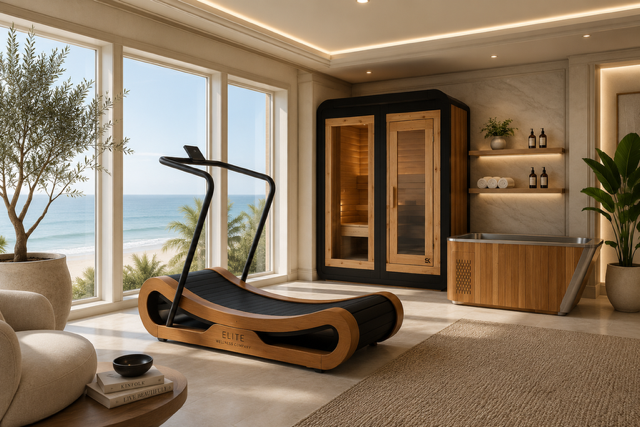
How Does a Curved Treadmill Work? The Science Simplified
How Does a Curved Treadmill Work?
Unlike a traditional treadmill, a curved treadmill doesn't have a motor. Instead, the belt moves only when you move it.
Here's the science:
When your foot lands, you apply force to the curved running surface. That force causes the belt to rotate beneath you. The harder you push, the faster the belt moves. Slow your stride, and the belt slows too.
This self-powered design means:
✔ You control your pace naturally
✔ Speed changes happen instantly—no buttons required
✔ Your muscles generate the movement rather than relying on a motorized belt
Because you're powering the movement yourself, your body controls every pace change naturally—whether you're walking, jogging, or sprinting.
Many athletes and coaches use curved treadmills for sprint training, interval workouts, and conditioning because they respond immediately to changes in effort.
Science takeaway: Your movement powers the treadmill—not the other way around.
Research has shown that self-powered curved treadmills can increase physiological demands, such as oxygen consumption and heart rate, compared with running at matched speeds on many motorized treadmills. Individual responses vary depending on workout intensity and the person.
Scientific references
These posts are based on findings from peer-reviewed exercise physiology research, including:
- Jones TW, et al. The Physiological and Perceptual Responses to Exercise on a Curved Non-Motorized Treadmill: A Systematic Review. Sports Medicine, 2021.
- Smoliga JM, Hegedus EJ, Ford KR. Research comparing physiological responses on curved non-motorized versus motorized treadmills.
- American College of Sports Medicine (ACSM) guidance on treadmill exercise physiology and energy expenditure.